
In brief
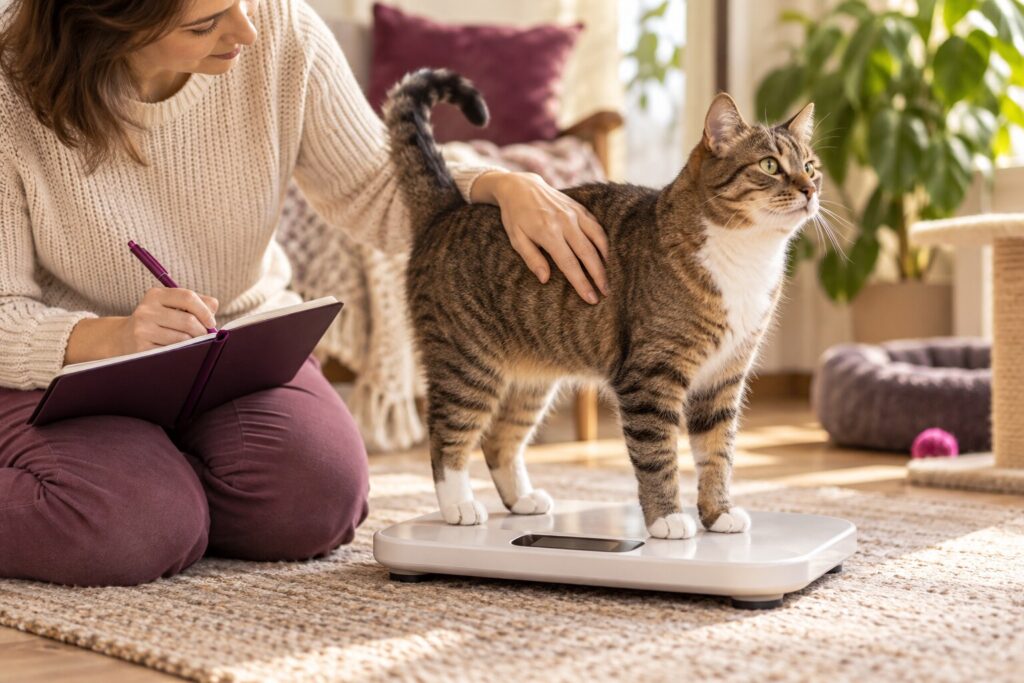
A healthy weight is not one fixed number for every cat of a particular breed. Assess three different things: scale weight, body fat and muscle mass. A cat may lose muscle without becoming much lighter, or remain overweight while muscles over the back decline. Follow trends. Unintended weight loss — particularly in an older cat — should not be dismissed as normal ageing, even when appetite remains good.
Why weighing alone is not enough
“She still weighs exactly five kilograms” sounds reassuring. It does not reveal what those five kilograms consist of.
A cat may:
- Lose fat while preserving muscle
- Lose muscle with little overall weight change
- Carry excessive fat and inadequate muscle at the same time
- Grow or lose weight without obvious visual change beneath a long coat.
Veterinary nutrition and feline guidelines therefore recommend recording body weight, body condition score and muscle condition score.
Three measures, three questions
1. Body weight
The scale measures total mass. The pattern over time is often more informative than a single value.
For useful comparisons:
- Use the same home scale
- Weigh under similar conditions
- Record date and weight
- Follow the trend over weeks and months
- Do not overinterpret small differences between unrelated scales.
A few hundred grams can represent a meaningful proportion of a small cat’s body weight. Consider percentage change and speed as well as grams.
2. Body condition score: how much body fat?

Body condition score, or BCS, is a standardised assessment of body fat. Many practices use a nine-point scale. Approximately 4–5/9 is generally regarded as ideal, although interpretation belongs to the individual patient.
In a cat with appropriate body condition:
- Ribs are easy to feel with gentle pressure and without a thick fat covering
- A waist is visible behind the ribs from above
- A slight abdominal tuck is visible from the side.
The normal abdominal skin fold, or primordial pouch, does not by itself prove that a cat is overweight. Consider the whole body and gently feel the ribs and contours only when the cat is comfortable with this.
3. Muscle condition score: how much muscle?
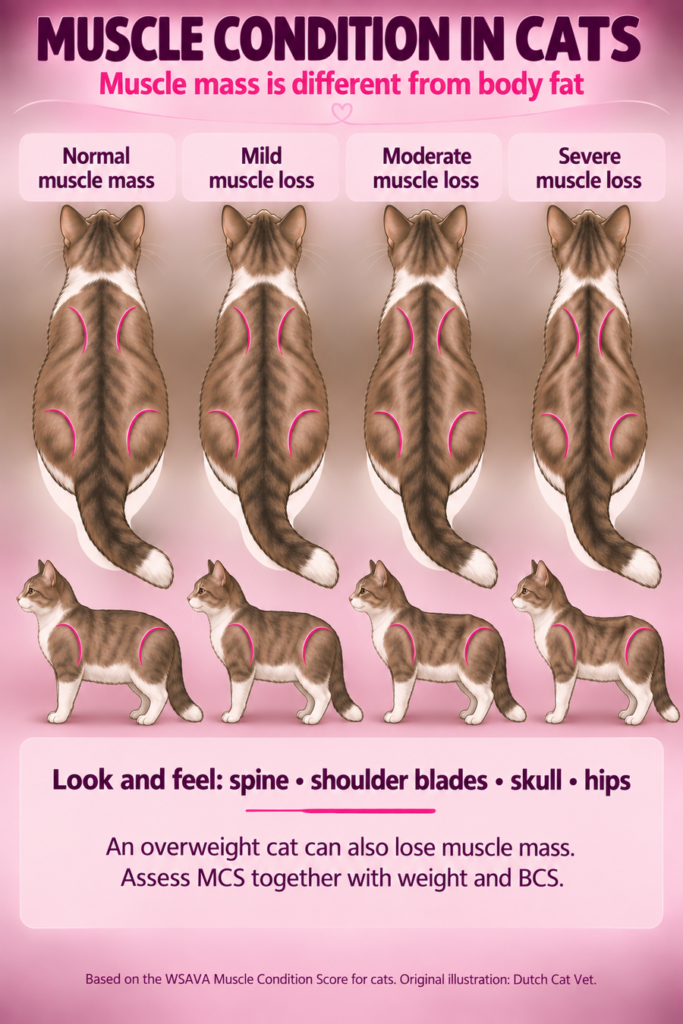
Muscle condition score, or MCS, assesses muscle mass, including areas around the spine, shoulder blades, skull and pelvis.
Muscle loss is not the same as being thin. An overweight cat can lose muscle too. Body weight may therefore look stable while composition becomes less favourable.
At home you may notice:
- A more prominent spine or shoulder blades
- Thinner hindlimbs
- Reduced power when jumping
- A more angular frame despite persistent abdominal size.
Assessment is not always easy. Ask your veterinarian to demonstrate BCS and MCS and record them as separate trends.
When is a cat overweight?
Excess weight develops when energy intake exceeds expenditure over time. Causes and solutions remain individual. Food, portions, treats, activity, age, neutering, environment and disease may all matter.
Possible clues include:
- Ribs are difficult to feel
- The waist is poorly defined from above
- Abdominal contours become rounder
- Grooming, movement or jumping becomes difficult.
Reduced jumping is not automatically a weight issue alone. Pain, osteoarthritis, neurological and other disease may contribute.
Why “just feed less” may be unsafe
A safe weight-loss plan protects muscle and still provides essential nutrients. The appropriate quantity depends on the diet, present condition, goal, health and activity.
Do not suddenly impose a severe homemade restriction. Cats who eat very little or stop eating may become seriously ill; overweight cats are particularly at risk of hepatic lipidosis. Contact a veterinarian if your cat refuses food or eats substantially less.
A good plan commonly includes:
- A realistic individual target
- A calculated amount of complete food
- Agreement about treats and extras
- Gradual transition when a dietary change is needed
- Activity and food enrichment suited to the cat
- Regular weight and condition monitoring
- Adjustment when muscle, appetite or health changes.
When is a cat too thin?
With a low BCS, ribs, spine and pelvis may be more visible or palpable and fat stores are reduced. A cat may instead lose predominantly muscle while retaining fat.
Unintended weight loss can have several causes.
Reduced food intake or nutrient use:
- Reduced intake due to pain, nausea, stress or oral disease
- Gastrointestinal, hepatic or pancreatic disease
- Unsuitable food provision or competition around feeding
- Age-associated changes in digestion and body composition.
Diseases that alter energy use or muscle mass:
- Chronic kidney disease
- Hyperthyroidism
- Diabetes mellitus
- Chronic inflammation, infection or a tumour.
This is not a home diagnostic list. History, examination and targeted investigations determine the cause.
“She eats very well but still loses weight”
A good or increased appetite does not make weight loss harmless. Cats with hyperthyroidism or diabetes may lose weight despite eating well or even excessively. Some gastrointestinal disease may cause weight loss before vomiting or diarrhoea becomes obvious.
Arrange veterinary assessment for a genuine downward trend, even when your cat remains cheerful and enthusiastic about food.
Is weight loss normal in an old cat?
Older cats experience changes in lean mass, fat mass, activity and sometimes digestibility. This does not mean unintended weight loss should be accepted without assessment as “normal ageing”.
In a senior cat, a falling trend may be an early indication of disease or inadequate energy and nutrient uptake. Muscle loss may contribute to weakness and frailty. Consider:
- What and how much the cat truly eats
- Drinking, urination, vomiting and faecal changes
- Oral health and swallowing
- BCS and MCS
- Mobility and pain
- Medication and known disease
- Whether blood, urine, blood-pressure or other investigation is appropriate.
Age is not a disease. Weight loss is information.
How often should you weigh at home?
Monthly weighing can be a useful routine for a stable, healthy adult. Growth, weight treatment, senior age or disease may require a different schedule agreed with your veterinarian.
A calm method:
- Use a stable, appropriate scale.
- Encourage your cat to enter a basket or box voluntarily.
- Subtract the empty container’s weight.
- Record the result without reacting to tiny daily fluctuations.
- Combine weight with photographs from above and the side and observation of muscle condition.
Do not turn weighing into a struggle. If it causes stress, ask your practice for an alternative approach.
When should you call your veterinarian?
Contact your veterinarian about changes in weight or body shape when:
- Your cat unintentionally gains or loses weight
- Ribs, spine or pelvis become more prominent
- Hindlimbs appear thinner or weaker.
Also make contact when:
- Appetite changes
- Drinking or urination changes
- Jumping, walking or grooming becomes difficult
- Vomiting or faeces change
- Your cat eats very little or nothing.
With rapid change, food refusal or an unwell cat, do not wait for the next monthly measurement.
Final thought
The best “ideal weight” is not a breed average or automatically the lowest number ever recorded. It is a weight accompanied by appropriate fat stores and good muscle mass, suited to the individual cat’s health and life stage.
Follow the trend, look and feel carefully, and discuss change without judgement. Weight care is not about blame; it is about health, comfort and quality of life.
Try Pip’s monthly check and record weight, body shape and mobility as three separate observations.
Pip’s Post offers an occasional friendly reminder to notice these small changes.
Medical disclaimer
This information does not replace individual nutritional advice, examination or treatment by your veterinarian. Discuss changes in diet or energy intake with the treating veterinarian in illness, weight loss or marked obesity.
Sources
- Quimby JM, Gowland S, Carney HC, et al. 2021 AAHA/AAFP Feline Life Stage Guidelines. J Feline Med Surg. 2021;23:211–233. https://doi.org/10.1177/1098612X21993657
- Cline MG, Burns KM, Coe JB, et al. 2021 AAHA Nutrition and Weight Management Guidelines for Dogs and Cats. J Am Anim Hosp Assoc. 2021;57:153–178. https://www.aaha.org/resources/2021-aaha-nutrition-and-weight-management-guidelines/home/
- Freeman L, Becvarova I, Cave N, et al. WSAVA Nutritional Assessment Guidelines. J Small Anim Pract. 2011;52:385–396. https://wsava.org/global-guidelines/global-nutrition-guidelines/
- WSAVA Global Nutrition Committee. Body Condition Score – Cat. https://wsava.org/wp-content/uploads/2025/06/WSAVA_BCSCat_BCSCat_Nutrition_250612.pdf
- WSAVA Global Nutrition Committee. Muscle Condition Score Chart. https://wsava.org/wp-content/uploads/2020/01/Muscle-Condition-Score-Chart-for-Cats.pdf
- Ray M, Carney HC, Boynton B, et al. 2021 AAFP Feline Senior Care Guidelines. J Feline Med Surg. 2021;23:613–638. https://doi.org/10.1177/1098612X211021538
—
Kleine veranderingen eerder zien
Ontvang direct Pip's Senior Cat Check, twee korte welkomsttips en daarna ongeveer één keer per maand begrijpelijke kattenkennis van Pip en Marieke.
Pip’s Post wordt klaargezet. Inschrijven opent zodra de e-mailverbinding betrouwbaar is getest.