
In brief
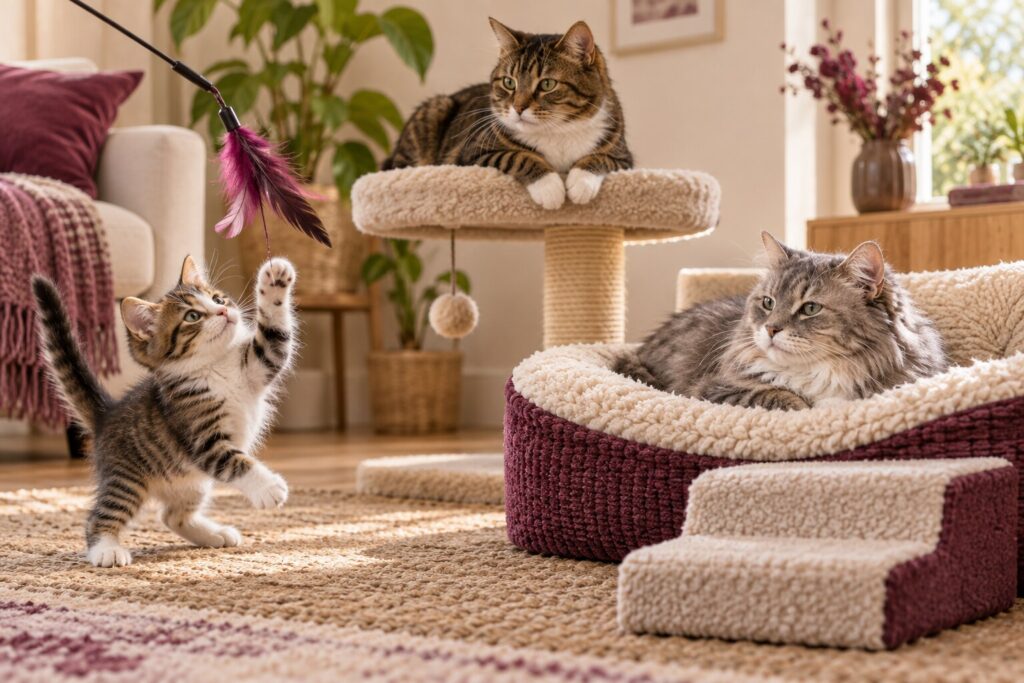
A kitten is not automatically the best choice, and an adult or older cat is not second best. The right match depends on time, energy, need for predictability, living space, other animals, children and financial resources. An adult cat’s personality is often easier to describe, while a kitten generally needs more guidance. Use this information and our short matching guide to begin a conversation with a reputable rescue or responsible breeder — not as a test that identifies one perfect cat.
Start with daily life, not age
Colour, breed or one irresistible photograph may catch your attention first. A sustainable match depends on different questions.
Your daily life:
- How much time and energy do you have each day?
- How long will the cat usually be alone?
- Are there children, cats, dogs or other animals?
- Do you want an active companion or mainly calm company?
Your preferences, home and future:
- How important is a reasonably predictable personality?
- Can you fund both routine and unexpected care?
- Can your home provide resting places, height, litter trays and separated resources?
- What is likely to change in your life over the next fifteen years?
No single answer makes someone automatically suitable or unsuitable. These questions are more realistic than assuming that a kitten will fit into any home.
When might a kitten suit you?
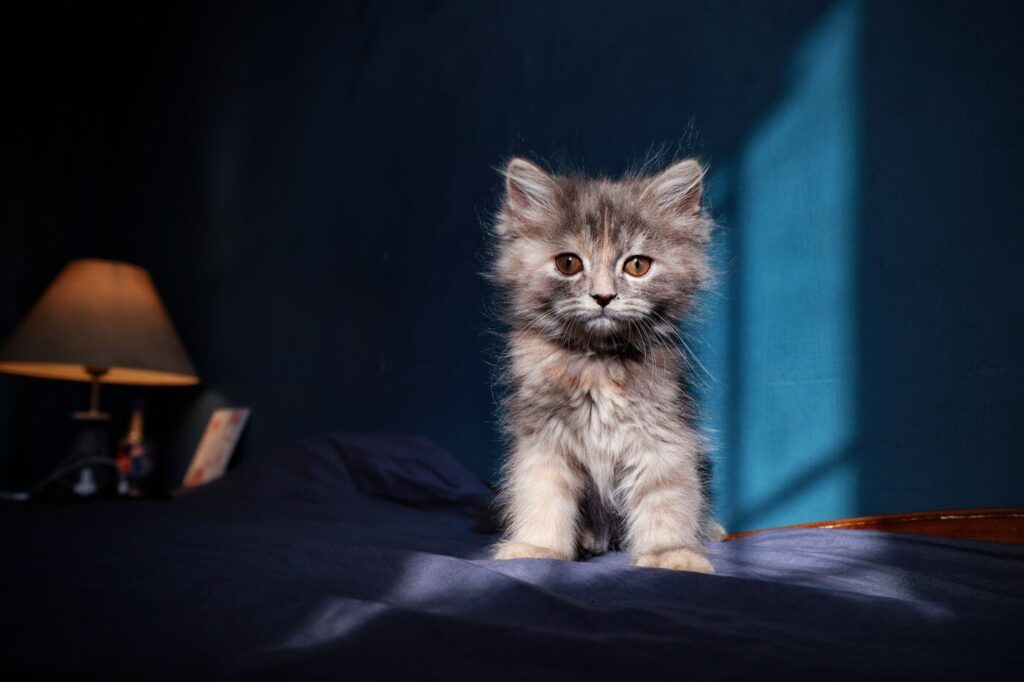
A kitten may suit someone who has time and enthusiasm for guidance, play and gradual introduction to new experiences. Kittens still have much to learn, and future temperament, activity and healthcare needs are not fully predictable.
A kitten does not need to move as young as possible to bond with a new family. Preferably choose a moving age of around 12–14 weeks. The Dutch legal minimum of seven weeks is not the same as the ideal age. Pedigree associations may also set their own rules: FIFe and Mundikat currently require at least 14 weeks, while some other associations use 13 weeks.
Expect:
- Several short play sessions each day
- Thorough kitten-proofing
- Gentle preparation for carriers, handling and routine care
- Guidance around scratching, biting and nocturnal activity
- Kitten veterinary visits and an individual preventive-care plan
- Potentially substantial disruption for an older resident animal.
A kitten does not need to be “dominant” to overwhelm another cat. Normal youthful play may simply be too intense for a mature cat who did not request a new companion.
When may an adult cat be a better match?
Personality, activity and social preferences are often easier to describe in an adult. A good rescue or previous caregiver may know whether the cat seeks laps, has lived with children, wants outdoor access, avoids other cats or has an established feline companion.
An adult may suit you when you:
- Value greater predictability
- Do not want the most intensive kitten stage
- Have specific household requirements
- Prefer to choose by personality rather than appearance
- Are open to a cat with an existing history.
That history may be incomplete. Ask what is confirmed, what is suspected and what remains unknown.
What about a senior cat?
Senior cats are the best — at least Pip considers that point settled. They may be calm, wise and wonderful company. Age is not a disease.
Ageing can, however, accompany changes in oral health, mobility, muscle mass, blood pressure, kidneys, thyroid or other systems. This does not mean every older cat is unwell; it makes clear information and a realistic care plan important.
Before adoption, ask about:
- Recent examinations and test results
- Current diet, medication and supplements
- Mobility, jumping and litter-tray use
- Dental health and eating behaviour
- Known chronic conditions
- Likely monitoring and cost
- Helpful environmental adaptations.
Adopting a senior is not merely charitable. It may simply be the best mutual match.
One cat or two?

The honest answer is that it depends on the cats.
Cats can form close social bonds, but do not automatically welcome every feline housemate. Relatedness or growing up together does not guarantee lifelong compatibility. Conversely, two clearly bonded cats may provide valuable social contact for each other.
Instead of asking only “Should I take two?”, ask:
- Are these particular cats demonstrably affiliated?
- Do they choose to rest together, groom or interact amicably?
- Is there enough space to avoid each other?
- Can food, water, litter trays, resting places and scratching opportunities be provided in multiple separated locations?
- Can you fund veterinary care for two?
- Does kitten energy suit the resident cat?
Do not choose a pair solely because two is supposedly always better. Do not separate an established, compatible pair only because you originally planned for one.
If a cat already lives with you
A second cat is not automatically a gift to the first. Some cats benefit from a compatible social partner; others prefer not to share their home with another cat.
Consider the resident cat’s history and preferences. Age alone does not predict compatibility. A young, active cat may overwhelm a calm senior, while two adults may also develop tension when space, introduction or social preferences are mismatched.
Plan a gradual introduction with separate spaces initially. Distribute resources and allow both cats control over distance and contact. Forcing them to eat or sleep together, or expecting them to “sort it out”, is not an appropriate introduction strategy.
Dogs and children
“Good with children” and “good with dogs” are too broad to be very helpful.
Ask instead:
- The age and behaviour of the child
- Whether interaction can be supervised and predictable
- Whether the cat has high and private safe places
- Whether the dog has lived calmly with cats
- Whether chasing behaviour can be managed
- Whether this individual cat has positive, neutral or negative experience.
A kitten is not automatically safer with a dog, and a calm adult is not automatically suitable for young children. The individual combination matters.
Indoor, outdoor or protected access?
The lifestyle you can offer should suit the cat. An adult who has freely roamed outdoors for years may struggle with an exclusively indoor life. A kitten can live well indoors when the environment provides choice, play, climbing, scratching, rest and predictability.
Secure outdoor access may be useful for some households. The right choice depends on the individual cat, home, neighbourhood, welfare and risk.
Costs matter
Purchase or adoption cost is a small part of a cat’s lifetime needs. Consider:
- Appropriate food and litter
- Adequate litter trays and other resources
- Vaccination and parasite control based on individual risk
- Examinations, dental care and neutering
- Insurance or dedicated savings
- Acute illness and chronic medication
- Care during holidays or owner illness.
An older cat is not automatically more expensive, and a kitten is not automatically inexpensive or healthy. Budget for the individual animal.
Use the matching guide appropriately
Our short guide helps organise your circumstances and preferences. The result is not a behavioural assessment, medical screen or guarantee of compatibility.
Use it to ask better questions. People who know the available cats can then consider which personality and care needs may genuinely suit your household.
Questions for the rescue or breeder
About this cat:
- What is confirmed about temperament and what remains uncertain?
- How does this cat respond to handling, visitors and novelty?
- Has the cat lived with children, dogs or cats — and what exactly did that look like?
- Is there a clear social bond with another cat?
- Which home and lifestyle is familiar?
About care and support:
- Which food, medication or supplements are given?
- Which health information and records are available?
- Why do you think this cat suits my household?
- What support is available during settling in?
A good organisation or breeder asks you questions too. That is not unnecessary gatekeeping; it shows that matching matters.
Final thought
The best cat is not necessarily the youngest, prettiest or rarest. It is an individual whose needs match what you can provide over the long term.
Take your time. A good decision should not require pressure.
Try the matching guide on How do you keep your cat healthy? and use the result to begin a conversation with a rescue or breeder.
Once your new companion arrives, Pip’s Post offers occasional, reliable feline information without daily email.
Sources
- LICG. De aanschaf van een kat. https://www.licg.nl/katten/de-aanschaf-van-een-kat/
- Dutch Society for the Protection of Animals. Een kitten adopteren? https://ikzoekbaas.dierenbescherming.nl/tips/katten/een-kitten-adopteren
- Quimby JM, Gowland S, Carney HC, et al. 2021 AAHA/AAFP Feline Life Stage Guidelines. J Feline Med Surg. 2021;23:211–233. https://doi.org/10.1177/1098612X21993657
- Rodan I, Ramos D, Carney HC, et al. 2024 AAFP Intercat Tension Guidelines: Recognition, Prevention and Management. J Feline Med Surg. 2024;26(7):1098612X241263465. https://doi.org/10.1177/1098612X241263465
- Ellis SLH, Rodan I, Carney HC, et al. AAFP and ISFM Feline Environmental Needs Guidelines. J Feline Med Surg. 2013;15:219–230. https://doi.org/10.1177/1098612X13477537
- International Cat Care. Introducing cats. https://icatcare.org/articles/introducing-cats
- International Cat Care. Multi-cat households. https://icatcare.org/articles/multi-cat-households
- Netherlands Food and Consumer Product Safety Authority (NVWA). Buying and caring for dogs and cats. https://www.nvwa.nl/onderwerpen/dier/honden-en-katten/honden-en-katten-kopen-en-verzorgen
- FIFe. Breeding & Registration Rules – re-homing of kittens. https://fifeweb.org/health-welfare-rules/
- Mundikat. Basic rules of cat associations. https://www.mundikat.nl/index.php/de-basisregels/
—
Kleine veranderingen eerder zien
Ontvang direct Pip's Senior Cat Check, twee korte welkomsttips en daarna ongeveer één keer per maand begrijpelijke kattenkennis van Pip en Marieke.
Pip’s Post wordt klaargezet. Inschrijven opent zodra de e-mailverbinding betrouwbaar is getest.