
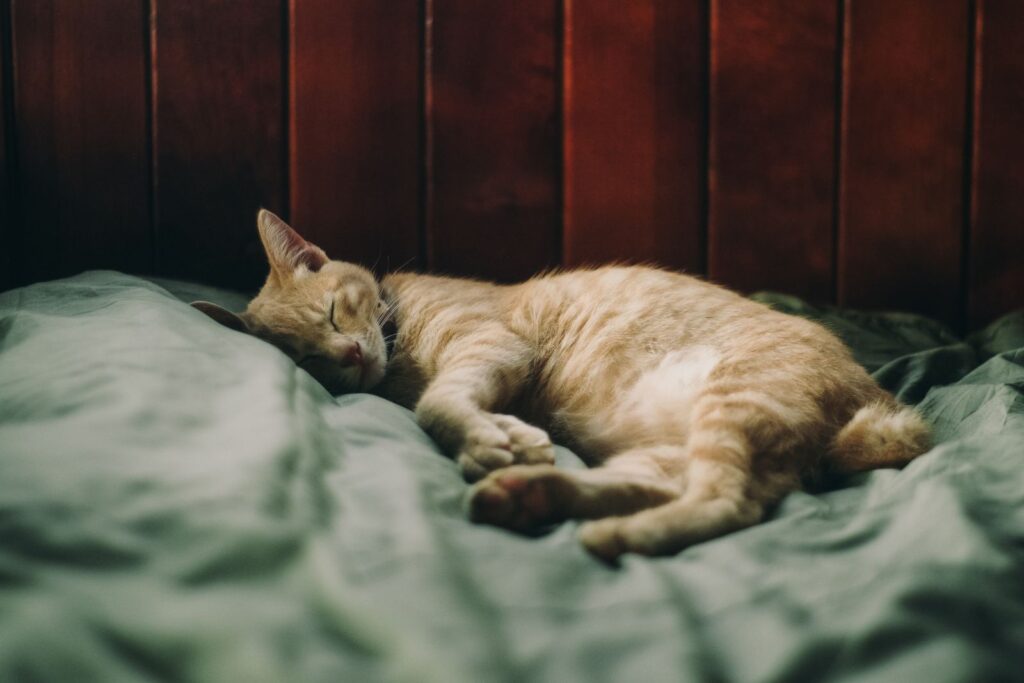
In brief
A healthy cat usually takes fewer than 30 breaths per minute while asleep. If you repeatedly count more than 30 breaths per minute while your cat is sleeping, contact your vet. Faster breathing at rest can be an early sign of heart or lung problems.
Why count your cat’s breathing?
Cats are good at hiding illness. Breathing that slowly speeds up at rest is often one of the first things you can measure at home. Especially in heart disease, a rising sleeping breathing rate can be an early sign that fluid is building up in or around the lungs. Counting takes one minute and costs nothing.
How do you count your cat’s breathing?
- Choose a moment when your cat is sleeping calmly, not right after playing or eating.
- Make sure your cat is not purring, as that makes counting unreliable.
- Watch the chest or flank: one rise and fall is one breath.
- Count for 30 seconds and multiply by 2. That gives you breaths per minute.
- Write down the result with the date and time. An app or a simple list works fine.
How many breaths per minute is normal?
In healthy cats the breathing rate during sleep is usually below 30 per minute. Many cats with heart disease but no symptoms also stay below 30. Awake and at rest, a cat breathes a little faster than when asleep. At the vet, stress can push breathing much higher, which is why measurements at home are so valuable.
More important than a single measurement is the trend. Once you know your own cat’s normal number, you will notice changes sooner.
When should you contact your vet?
- More than 30 per minute during sleep, several times: call your vet for advice.
- Fast breathing with effort, such as the belly moving with every breath, a stretched neck or restlessness: contact your vet the same day.
- Open-mouth breathing, a blue or grey tongue or gums, or struggling to breathe: this is an emergency. Go to a vet immediately.
What can cause fast breathing?
Faster breathing is a sign, not a diagnosis. Possible causes include heart disease with fluid in or around the lungs, airway problems such as asthma, fluid in the chest from other diseases, anaemia, fever, pain and stress. Your vet looks for the cause with a physical examination and often ultrasound or X-rays.
Tip for cats with heart disease
Does your cat have heart disease? Agree with your vet how often to count the sleeping breathing rate and at what number to call. That way you can often spot problems before your cat is truly short of breath.
Read also
Medical disclaimer
This information does not replace an examination by a vet. Is your cat struggling to breathe, breathing with an open mouth, or are the gums blue or grey? Go to a vet immediately.
Sources
- Ljungvall I, Rishniw M, et al. Sleeping and resting respiratory rates in healthy adult cats and cats with subclinical heart disease. J Feline Med Surg 2014;16:281–290
- Porciello F, Rishniw M, et al. Sleeping and resting respiratory rates in dogs and cats with medically-controlled left-sided congestive heart failure. Vet J 2016;207:164–168
Photo: Dương Nhân via Pexels
Spot small changes sooner
Get Pip's Senior Cat Check now, two short welcome tips, and then clear, practical cat health information from Pip and Marieke about once a month.